Sunday, December 2, 2018

Australian reprint of Janet Frame's autobiography


A refreshed Australian edition of Janet Frame's complete 3-volume autobiography was published earlier in 2018, now under the Penguin imprint.

In addition several other major Janet Frame titles are available from Penguin Australia as paperbacks or as ebooks:


  • Janet Frame in her Own Words
  • The Daylight and the Dust: Selected Stories
  • Faces in the Water
  • Living in the Maniototo
  • Towards Another Summer
  • An Angel at My Table (the Complete Autobiography)

See the complete list of Janet Frame titles available from Penguin Australia on their website.


Janet Frame VMC editions now available in NZ


Good News!! These Virago Modern Classic editions of key Janet Frame titles are now distributed in New Zealand through Hachette NZ:
  • Towards Another Summer, 
  • The Daylight and the Dust: Selected Short Stories, 
  • Faces in the Water, 
  • An Angel at My Table: The Complete Autobiography, 
  • Living in the Maniototo.
Affordable good quality paperbacks with brilliant and insightful introductions from illustrious Janet Frame aficionados such as Hilary Mantel and Jane Campion.

Available at all good booksellers. If they don't stock Janet Frame, please ask them why!


Janet Frame poems in Spanish journal

 A selection of 15 of Janet Frame's poems in Spanish translation have been published in Spanish literary journal Palimpsesto 33 (Seville, 2018).


The day Lottie died


Grandma Lottie Clarice Frame née Godfrey was born on the 29th of February 1892. She grew up in Picton and as a young girl she worked as a housemaid in Katherine Mansfield's grandmother's house. Katherine - also just a girl - came to stay for the holidays and Lottie met her, forming a fond impression. I like to think KM got the name 'Lottie' that she uses in her fiction from meeting Grandma, and maybe she also drew on the real Lottie as a character for a walk-on part in some of her portrayals of the servant class.

Grandma died on this day in 1955, on Friday the 2nd of December. Janet was living in the hut at Frank Sargeson's place and made the mistake of crying and being generally upset on hearing of her mother's death. This was of course pathologised by the patronising men around her. If you have been given a psychiatric label, however wrong the diagnosis is, then nothing you ever do is interpreted as normal, even though grief is normal.

Janet often remarked on this dilemma. Everything she did was open to being interpeted as 'mad' or 'odd' or 'weird' by people who approached her with this expectation. People who could behave in a similar way and would themselves not welcome being called 'disturbed' for it.

To this day Janet's former friend CK Stead, the very epitome of an arch frenemy, will tell you Janet was 'forever' crying in those days. 

When he doesn't suddenly remember how witty and quick and what fun she was. 

It is easy to trace the inconsistencies in Karl Stead's pronouncements about Janet Frame over the years. He has contradicted himself so much, depending on whether his present aim is to belittle her (presumably he is envious of her success having vastly eclipsed his modest reputation) or to boast about having once been close to her.

"Today is the day mother died..." Janet and Mum used to say every year on the 2nd of December and so even though I never met my grandmother, I still can't help observing her anniversary. Lottie's influence was strong in my life both through the combined oral histories passed down by my mother and my aunt and of course through the written word - Janet's writings and Lottie's poems.

Janet wrote in her autobiography about the day Lottie died and how jealous and angry she was that her sister June had heard the bad news first:

"I was jealous of my sister’s first knowledge of the death, almost as if it were a treasured gift chosen to be given to her, then passed on, used and soiled, second-hand, to me."

Janet was at that time living and working at Frank Sargeson's hut during the week and then staying with June and her young family over the weekends. That one weekend, just after her mother died on the Friday, was one of the rare occasions when Janet chose to stay at Frank's place for the weekend and not go to June's place. She was grieving and she was mad at her sister and the rest of the family for having sent her the news of her mother's death second-hand, and she didn't want to go to their place. It was a rare falling-out between my mother and Janet, and it was brief.

You do cry when your mother dies, and families often go through turmoil and there are recriminations and old rivalries surface.

Janet was mad, mad=angry. In that generation the word mad meant angry more than it does now. And she didn't want to see anyone. And she wrote a note to June and to Frank to the effect that she was mad and not coming out that weekend. Not coming out to see June, not coming out to see anyone. Staying in the hut. Grieving.

Janet had overheard Frank and his acolytes sniggering about the 'mad girl' in his garden so her choice of the word 'mad' for 'angry' was a typical one for her, rhetorically and linguistically. Many of the things Janet said were well over the heads of slow-thinking people or dullards and they often mistook her meaning. I saw that many times. She wasn't crazy but she could be mean, and she did play with people that way sometimes. She just couldn't help saying something that had several valid meanings simultaneously, and most of us only grasped one or two levels. She relished Frank Sargeson's company because he at least could get the literary allusions and they enjoyed a marvellous banter. Janet was a quick thinker and had a scintillating wit and Sargeson and Stead are both on the record testifying to that fact.

It's actually hard for a genius like Janet Frame to find soulmates and compatible people that she could even converse with in a satisfying way, without them thinking she was odd, and New Zealand was a small pool for someone like Janet. Katherine Mansfield and Frances Hodgkins both fled and never returned to New Zealand for similar reasons I guess. Janet knew she was misunderstood in her own country but her love for it kept drawing her back. She also had an extra compassion and empathy that meant she was able to communicate easily with a wide range of people from different backgrounds.

Now Frank Sargeson kept that note and it is in his archived papers, and some fools have used their knowledge of this note where she said she was mad for decades to whisper that the 'truth' about Janet has not yet been revealed! There is a smoking gun! They claim that she admitted she was 'mad' despite publicly having denied having the various diseases and disorders and conditions she has been misdiagnosed with over the years by total strangers, based on her fiction and on malicious gossip and just on stupidity.

Oh how those (mostly) men have spluttered with the frustration of not being able to flourish the 'evidence' that Janet wasn't misdiagnosed after all, she was as mad as a hatter! And said so herself!

Copyright law forbids the use of the wording of the unpublished note without legal permission, but the Sargeson 'mafia' have in all sorts of ways hinted at its existence over the years. More fool them, for being as thick as pigshit and missing a simple and desperate pun.

The day after we buried Janet's ashes in the family grave at Oamaru, I had an urgent request from the archive holding the Sargeson papers, to allow a film crew to photograph that note, specifically.

It seemed like the vultures had been waiting until Janet had died.

The misogynist men of NZ Lit had always resented the 'rehabilitation' of Janet Frame from the diagnosis of schizophrenia. They preferred being able to put her in the 'mad' box where her "flashes of brilliance" (CK Stead) didn't outshine their own presumably more rational scribblings. 

And that wasn't the last time I have had to refuse permission for that small scrap of paper to be used or misused, more likely. Out of all the great archive of Janet Frame, that note has been the most requested. One curator wanted it to be on display at an exhibition - out of all her great work, the scrap of paper that said "I am mad" was what they felt the public should see.

How advisedly Janet Frame gave her mantle of literary executor to someone she trusted to discourage the misuse of biographical scraps which can be made to fit any agenda. It is the oeuvre as a whole of a great author that is their testament and Frame's body of work tells the truth about her. One angry or distressed note is no evidence for anything.

It takes a really loathesome person to not care for moral law, and indeed it was Frame's nemesis Professor Patrick Evans in his play Gifted who deliberately flouted Janet Frame's moral rights by having a naive actress besmirch Janet's memory by wearing a sign that trumpeted "I AM MAD" as though the real Janet really said that and meant what Frank and Patrick hoped she meant unironically.

A Contemptible Literary Hoax: Stage Prop from Professor Evans' Revenge Fantasy Play

Some people aren't very good at irony. This story indicates really how weak-minded but how malevolent the Evansian crusade is, and how ignorant his minions are. But what fun, what a jape it is, to kick a great woman in the teeth and revile her and reject her own witness and deny the truth of her own life story, steal and twist her history and exploit it for their own gain.

The great misogynist battle, and in the 21st century it is alive and well, 125 years after women first gained the right to vote in New Zealand. The co-opting and twisting of the narrative of Janet Frame's life is an unresolved feminist issue.


Saturday, December 1, 2018

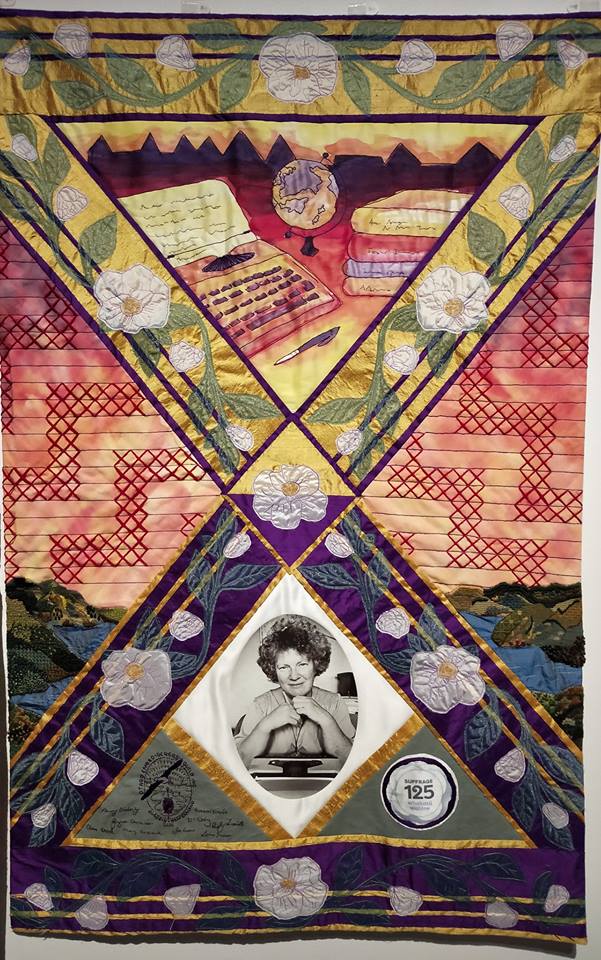
Suffrage Banner Honours Janet Frame


An embroidered women's suffrage anniversary banner honouring Janet Frame was unveiled this week on the 28th of November at Toitū Otago Settlers Museum in Dunedin to commemorate 125 years since the day New Zealand women first cast their vote. 


The Janet Frame banner joined another five banners dedicated to eminent Dunedin women that had been produced in 1993 to mark the centenary of Women's Suffrage. The banners were devised and created by members of the Otago Embroiderers' Guild and are currently on display at the Museum as part of an exhibition called Suffrage & Beyond. 


One of the earlier banners features Dr Emily Siedeberg, New Zealand's first female medical graduate, who was the doctor who delivered Janet Frame in 1924 at St Helen's Hospital in Dunedin.


Dunedin City Council CEO Sue Bidrose (left)  invited me, as chair of the Janet Frame Literary Trust, to join her in unveiling the Janet Frame banner. Sue Bidrose is the DCC's first female chief executive, and in a keynote speech later in the evening at the final Suffrage 125 event for 2018, she remarked on the fact that even though it is 125 years since women first won the right to vote, women are still celebrating "firsts".


The suffrage banners will be on display at the Suffrage & Beyond exhibition until July 2019.


Go Girl Makes Good


GO GIRL by Barbara Else was published in April to much applause and a warm welcome. There had been a yearning for "New Zealand's answer to Goodnight Stories for Rebel Girls" and GO GIRL made the grade. It fled off the shop shelves and into the hands of many, many grateful girls, families, teachers, librarians, and is still selling strongly (another Christmas gift idea!)

Small town girl made good Janet Frame is there in this volume with the other can-do girls who became successful women. Janet is reading the book prize she won at school: Boys and Girls who Became Famous, and she is dreaming of being a famous poet. This is a true story! That book is now on display at the North Otago Museum in Oamaru!

Can you imagine how many youngsters who read Go Girl now, will go on to be famous themselves just like Janet Frame did, by following their dream no matter what it costs them?

Illustration of Janet Frame by Sarah Wilkins

Go Girl: A Storybook of Epic NZ Women 
By Barbara Else (Puffin, 2018)


A New Zealand Waterbiography

"You bathe carefully, as you live, between the flags." ~ Janet Frame (from Owls Do Cry)


Here's another book hot off the press that I can highly recommend as a very good present. Buy Local!

Swim: A year of swimming outdoors in New Zealand by Annette Lees (Potton & Burton 2018). 

The title is a little misleading because the included diary of a year's worth of the author's swim-a-day, though entertaining, is not even the half of what is on offer here.

This is a well researched 'waterbiography' of  'wild swimming'in NZ, covering lots of different aspects. There are guest contributions, historical insights, potted biographies, chapters with titles like 'Night Swimming', 'Urban Creeks', 'Teaching Swimming', as well as one that discusses the different types of 'bomb' (jumping into the water with maximum splash).

And more. It's an interesting and educational book, well backed up with citations and bibliography, without being overly academic.


There are apposite quotes from NZ literature (several from Janet Frame) and many other relevant sources of information. And great illustrations.

I was a water baby myself, growing up, and very much enjoyed a trip down the memory lane of the school swimming pool.